Introduction
Architectural Components & Terminology
The major structures in are the hierarchical Ontologies. The elements or entities of an Ontology is a Category. Categories have Characteristics. A Characteristic is bound to a Category with a function called a Morphism. Morphisms have Targets that document the data properties of the Characteristic.
Ontological Structures
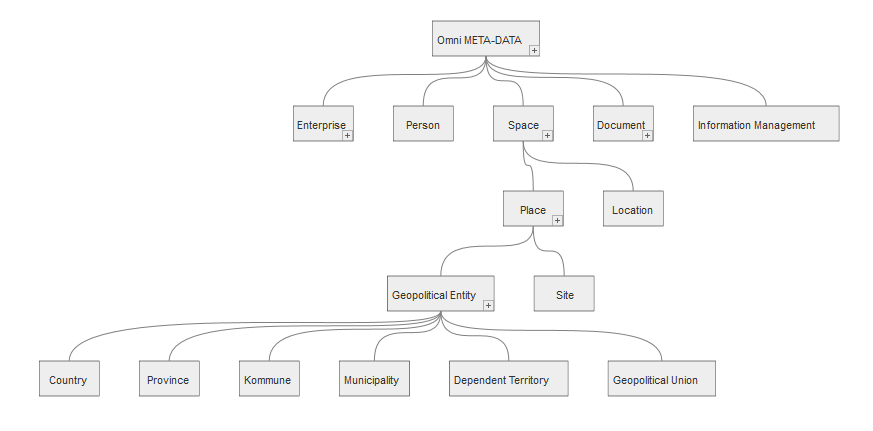
Ontologies provide a natural structure for information.
Ontologies provide an intuitive way of structuring information into domains of interest. IT Ontologies are extremely useful for structuring and associating information and have become popular and applicable since their introduction into IT, probably first in Artificial Intelligence in the early 1980s. They have become increasingly popular as there are many obvious benefits of the intuitive structure and organization and in that regard supersede the traditional class structures. Ontologies are ideally suited for organizing information with shared characteristics and structurally are part of our logical heritage and thus instinctively natural and easy to work with.
1
An Ontology is a hierarchical structure of meta-information.
An Ontology is a repository of meta-information—completely independent from any proprietary system, and thereby open and fully accessible by all.
Categories
Categories are the Entities of an Ontology
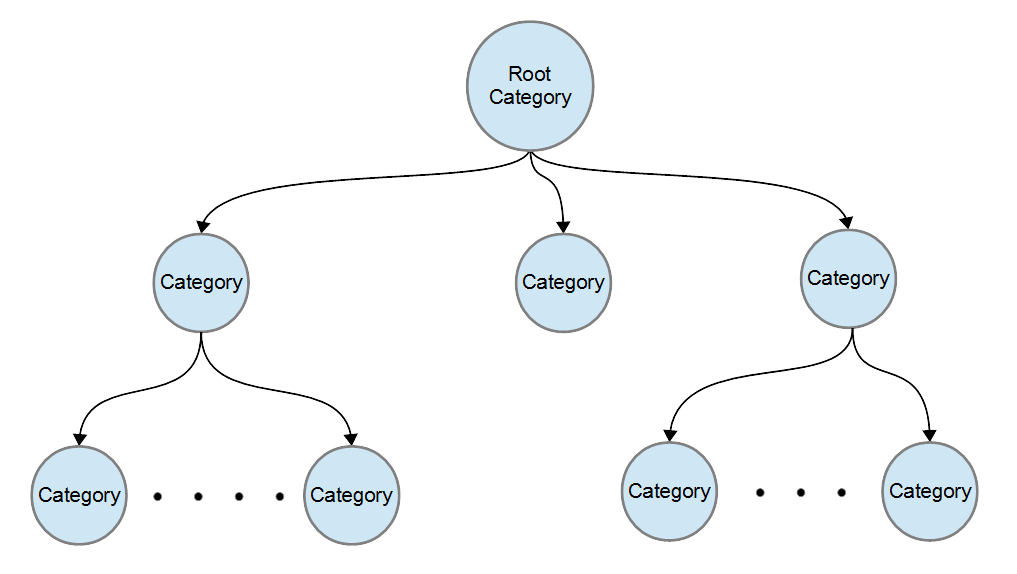
An Ontology is a hierarchical structure of Categories.
A Catgegory is a representation or definition of a particular information object type − sometimes referred to as a “business object”. In Categories are structred in Ontologies, i.e., each unit or entity in an Ontology is called a Category. A Category contains the conceptual and semantical information (meta-information) about information objects or business objects. The Ontological structures provide a natural and intuitive way of organizing, managing, and navigating through Categories as well as enhancing the larger picture of the understanding of the underlying data resources, relationships, and properties.
2
Categories are the entities of an Ontology.
Characteristics: Morphisms & Targets
The Characteristics of a Category Determine the Uniqueness of its Domain
A Category is determined alone by its Characteristics.
Names and definitions are of course necessary, but they are not sufficient to determine the type of a domain. Names and dedefinition give an intuitive idea of the concept but that can be ambiguous. Intuition differs from person to person and although names can contribute to the semantical delineation, they are frequently confusing and more than often convey different conceptual meanings to different people. This often contributes to misunderstanding and ambiguities in the use of information and can lead to severe problems in systems design, analytics, implementations, etc. By relying on the characteristics of a Category, there can be no confusion or ambiguity. uses this principle and to delineate different types of information in logical and mathematical ways with the characteristics of Categories. (Names and descriptions, although necessary, are not sufficient to determine unambiguous Category domains.)
In 's Ontologies each category has a unique meaning and purpose and its uniqueness is determined by the intrinsic characteristics of the category. The characteristics of a category define its meaning and resolve the total semantical picture. And, it is the characteristics that are bound to the category that determine its domain.
Intrinsic and Extrinsic Characteristics
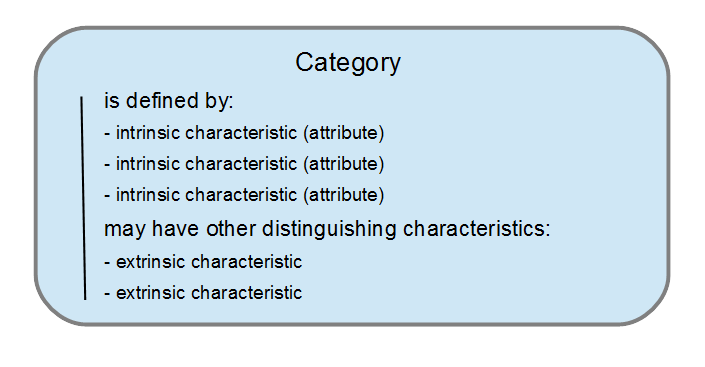
Knowledge about a Category comes from its intrinsic and extrinsic Characteristics.
In every Category is unique, i.e., mutually exclusive, or orthogonal. The differntiation is a result of defining unique characteristics on each Category. In there are intrinsic characteristics that determine the uniqueness of the Category domain and extrinsic characteristics that provide useful attributes. Characteristics add quality, properties, attributes to Categories and all those things that “belong” to a Category and it is the characteristics that determine the nature of the Category.
5
Morphisms bind Characteristics into Categories.
Intrinsic Characteristics determine existence
Intrinsic characteristics are those that are essential to a specific Category. For example, with the PERSON category, there are several obvious intrinsic characteristics that an instance of PERSON must have − these could be: birth-date, parents, birthplace, etc. Intrinsic characteristics are those characteristics that are so basic to the category that they determine its existence. In other words, if any of the intrinsic characteristics are missing, then an instance of the category does not legally (properly) exist.
Extrinsic characteristics
Extrinsic characteristics are those that enhance the semantic picture of a category, but are not essential to the existence of an instance. For example, with the PERSON category, several characteristics are often considered as necessary: national identification numbers that are often assigned at birth, names, color of hair, gender, etc. These characteristics are not essential to existence and therefore do not need to be present in an instance and even if they are they can change in value. For example, personal identification number, although many times are assigned at birth, are only the characteristic value of a relationship between the instance of a person and a particular country. Similarly, names can be changed, for example with a change of marital status.
Morphisms bind Characteristics to Categories
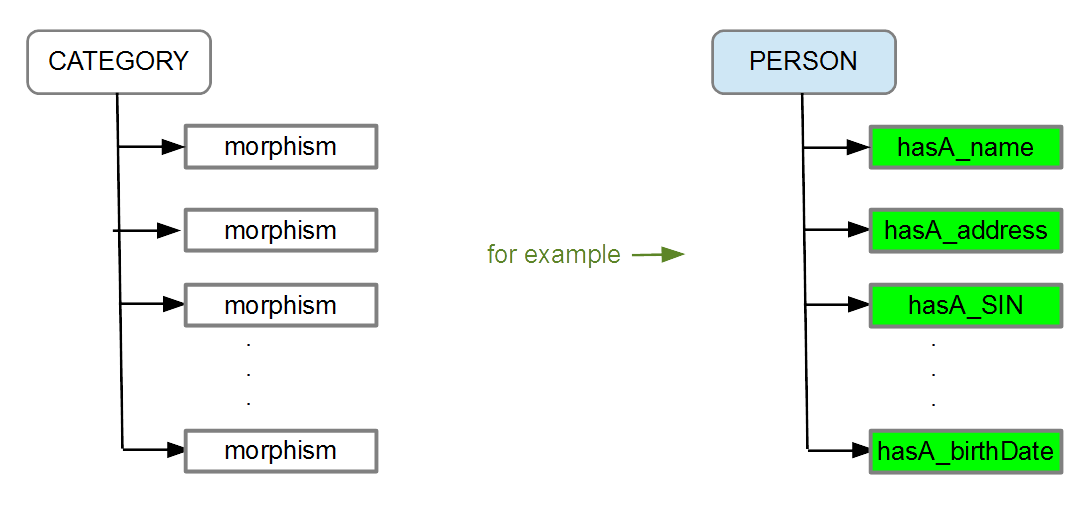
A Morphism binds or associates a Characteristic to a Category. A Morphism is a function from the Category and the data properties of the Characteristic − called the Target. The Morphisms of a Category, through the action of binding Characteristics to the Catgegory determine the uniqueness and conceptual aspects of a Category. Uniqueness is determined by the intrinsic characteristics and other conceptual aspects and relationships are created through Morphisms that associate extrinsic Characteristics to a Category.
For example, to associate the Category PERSON with an identity (such as a national ID number) a morphism such as “hasA_SIN” (e.g., Social Insurance Number − Canada), or “hasA_CPR” (as in Central Personal Registration number − Denmark) would be declared. Declaring one of these Morphisms (or both of them) on the PERSON Category would associate it (and its data properties − see targets below) with the Category.
6
An example of Morphisms binding Characteristics to a Category.
Targets of Morphisms
Morphisms have an action part and a Target.
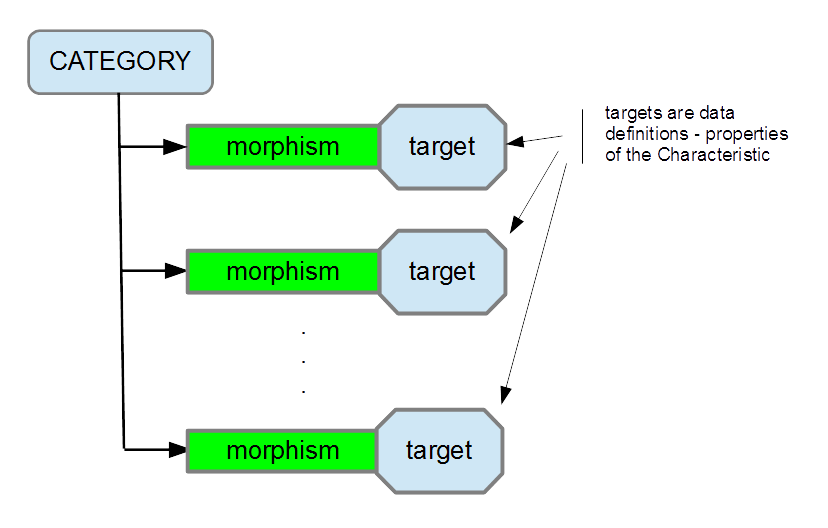
A Morphism, is part of the grammatical statement that associates a Characteristic with a Category. The Morphism or action part, completes the predicate with an object called the Target. The Morphism determines the semantics of the Characteristic. The Target is the data property description (data structure or format) of the Characteristic. The data properties that comprise a Target are proper IT representations of data types, e.g., XML schema fragments, JSON data structures, GUIDs, nominal lists, SQL scripts, etc.
7
Targets contain the data properties of Characteristics.
Summary
Category − Morphism − Target
The Morphism and Target bind a Characteristic to a Category.
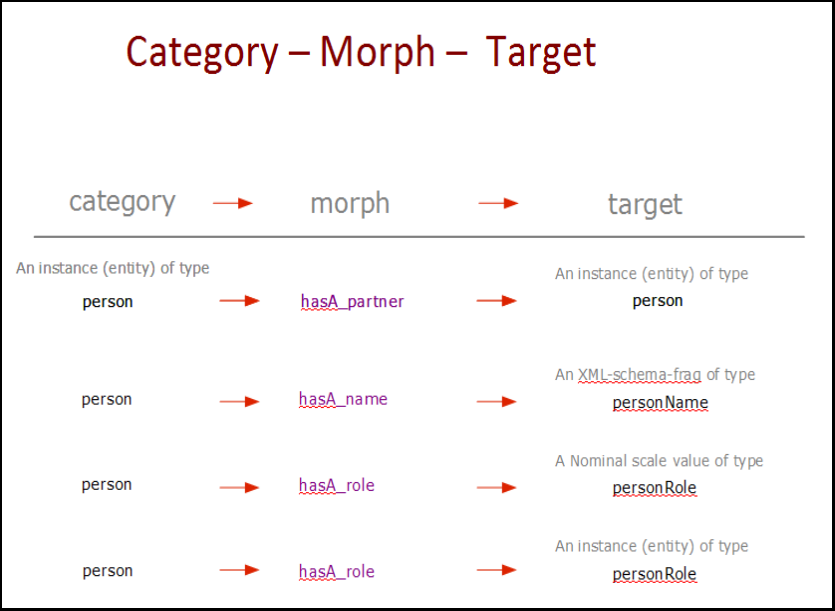
A Category represents a type of thing that functions as an Information Object within a domain. A Category is identified and distinguished by Characteristics; intrinsic Characteristics that determine its uniqueness and extrinsic Characteristics that for example, can relate a Category to itself to other Categories or to values.
Morphisms are the functions that define Characteristics; their semantics describe the mapping or transformations and their purpose.
Targets are the data properties specifying the value domains or ranges: of other Categories (identified by the identity Characteristic), other values such as Nominal Scale measures, numerics, alphanumerical strings, etc.
8
Data properties can be references (GUID), XML schema frags, nominal scale (lists), or string values.