ARTECA Introduction
Hugh A. Tucker, infoMenta Ltd.
Managing and utilizing data and information resources in the most effective manner is a goal for all organizations. But, success at the information logics level depends having well-structured, unambiguous, and complete documentation for all sources of information—a condition that is rarely met.
is a browser-based software system for documenting, structuring, and managing meta-information logically and effectively into Ontologies.
Meta-information is difficult to work with and often its use and access is restricted exclusively to IT experts with specialized proprietary systems. Categorizing and organizing meta-information into ontological structures frees us from this bias because ontological structures are intuitive, easy to understand, and easy to navigate. Thereby, meta-information becomes accessible to everyone in the corporation. Ontologies also have the advantage that they can be viewed, shared, updated, merged and interchanged.
An Ontology is a repository of meta-information, independent from any proprietary system—but nonetheless, open and fully accessible by all. Ontologies are a natural way of making meta-information more usable and accessible as well as greatly enhancing the larger picture of the understanding of the underlying data resources, relationships, and properties.
It is essential that organizations have first hand knowledge of: where their data is, how to access it, what it looks like, what security and/or privacy measures are in effect—or should be, how valid is it, and likely the most important, what is the significance and meaning of the information, and this must be available throughout the enterprise in a unambiguous and understandable form.
Introduction
integrates the concepts of Categories and Ontologies, into a natural and usable technology for organizing and documenting critical information & business objects.
The 's software services support and facilitate methodologies:
▹ Analyze
Use the methodology of and analyze the content of your information resources and programs—determining key information objects and increasing the ability to control your information governance.
▹ Categorize
Group and re-engineer information objects into Categories for efficient and unambiguous reference and attribution.
▹ Build ontologies
Ontologies are inherently natural, logical, and intuitive to work with—even non-technical users find them easy to use and understand. 's browser-enabled Ontologies are universally accessible knowledge bases.
▹ Semantics, attributes and characteristics
Categories are semantically documented, with attributes and characteristics that create useful meta-information repositories with semantically-rich definitions, relationships and data properties.
's software tools encourage collaboration between all: decision-makers to IT-experts. Common, unambiguous definitions, enable applications to be directly aligned with business goals and enhance the explicit and tacit corporate knowledge-base—bringing system-wide benefits.
The methodology associated with 's software tools encourages collaboration between all; decision-makers to IT-experts. Common, unambiguous definitions, enable applications to be directly aligned with business goals and enhance the explicit and tacit corporate knowledge-base—bringing system-wide benefits.
Categories
Categorizing objects into groups, classes or concepts based on similar characteristics is fundamental to human cognition, comprehension and communication—basic to how we process information. Categorization helps us to organize and understand the physical world through the creation of (our own) mental categories. We, as humans, are constantly categorizing and mentally structuring our world around us—processing the influx of information and turning it into knowledge. This is the essence of how humans learn. Without the cognitive savings that categories provide, we would be constantly bogged down with details and unable to abstract to higher levels. For example, imagine having to always think of “many, many trees“ rather than just “a forest” !! Without the abstraction that categories provide, we would be overwhelmed by the enormity of details that we are confronted with. (HT - any aha's relating to our Internet information overload!). The categorization of things is essential to human advancement and as far back as the ancient Greeks - Plato and Aristotle both attribute the ability to categorize as fundamental to our understanding.
Ontologies
Ontology is historically the study of what there is in the world, from the Greek Onto (being) and logica (written or spoken discourse). From the first simple list developed by Aristotle, structures of ontologies have developed through sets then trees and later the table formulations of Kent. Along with the structural developments, followed the relationships: from simple subject predicates to the linguistic challenges. For example, Ludwig Wittgenstein's conclusion was that there were no clear definitions which we can give to words and categories but only a “halo” or “corona” of related meanings radiating around each term.
The development of the IT ontology has been mainly as hierarchical data structure (tree or directed graph) encoded in some formal data structure, e.g.: OWL, RDF, XML, etc. and directed toward a common shared conceptualization. Common to IT ontologies is that they contain entities or terms together with a formal naming of types, properties, and interrelationships that describe a domain as an explicit computer-interpretable specification.
ARTECA's Categories and Ontologies"
is named after ARistotle's TEn CAtegories, and as such uses the (simple) model proposed by Aristotle in his Categories (Categories (Lat. Categoriae, Greek Κατηγορίαι Katēgoriai). In , the data structure of an ontology is a tree structure and the proposed methodology would have that entities are mutually exclusive. Relationships are implemented as morphisms - read more on in the white paper.
Using the System
Building Ontologies
's intuitive and user-friendly interface enables even non-technical users to structure and organize categories of enterprise information into ontological models. Once in the ontology, semantics can be added, documenting the categories with explicit corporate information and internal tacit knowledge. Further meta-information such as relationships and property values can be entered both by decision makers as well as IT experts. Using any browser, the ontologies can be viewed by all within the enterprise.
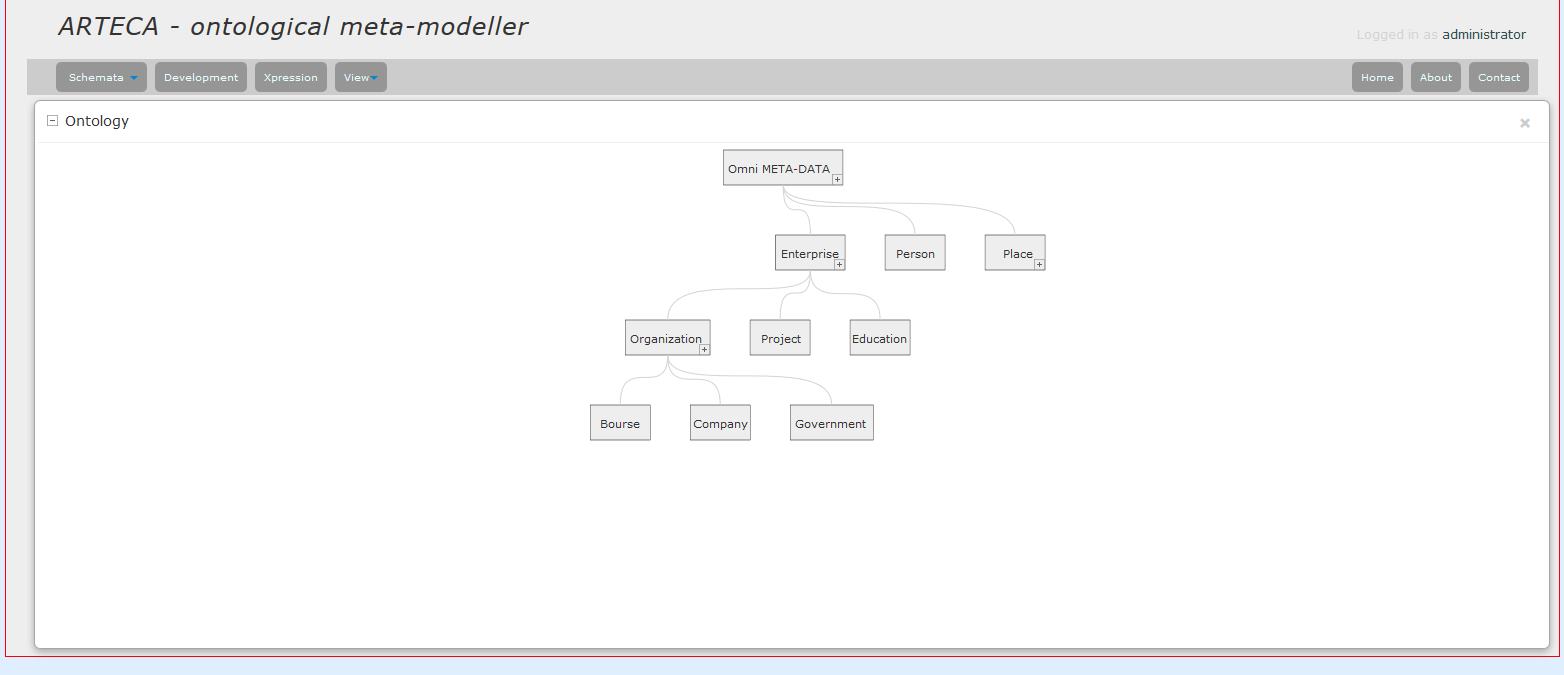
1
The ARTECA editor − an overview of a general ontology.
The ARTECA editor provides a simple and elegant way to:
– categorize enterprise data, information—meta-data & meta-information
– organize categories into ontologies
– annotate categories with meaningful semantics
– add attributes & relationships to categories
– document data properties, such as XML, access methods, security.
With ARTECA's interactive tools, all users can easily access and get first-hand knowledge of the corporate meta-information categories. In-depth information is available, on-line and with any browser enhanced by rich semantics, understandable characteristics and comprehensive relationships. As well, using the built-in tools, data structures can be extracted from the ontologies, merged, shared and inherited with other ontologies as well as exported as programmable data structures for use with applications, databases, and other systems. With , all levels of the organization can contribute and benefit with immediate access to the corporate tacit as well as explicit information.
Bridge Corporate Gaps and Strengthen Collaboration
provides all the corporate stakeholders: decision makers, managers, and information professionals with a way of working together on analysing and organizing the information about the enterprise's data resources and information content. Bridging semantic gaps between stakeholders is done by collaborating and obtaining consensus on the organizing of the corporate information into accessible and usable ontologies complete with documentation on the applicable terms. Using unambiguous definitions of the corporate information content means that decision makers and managers can use familiar terms when communicating with other sectors in the enterprise—including the IT experts. For example, requests for analytics can be given and results can be returned in the same familiar and mutually understood terms. Ontologies ensure that all corporate information is logically organized and semantically documented—strengthening understanding and providing for applicable and appropriate use of the enterprise's information resources.
Applying ARTECA
As an easy and effective tool for categorizing, organizing and documenting data and information resources there are several IT application areas in which 's functionality is particularly beneficially applicable and evident:
Creating Meta-Information Repositories
's ontologies provide a comprehensive repository of corporate information knowledge—available to all corporate stakeholders.
Creating rich and open meta-information repositories is one of the main applications. Opening up access to the corporate meta-information through ontological structures provides an extremely good visual and intuitive way to overview and understand the totality of the corporate IT information resources. For example, an ontological meta-information repository is a pragmatic basis for the many tasks associated with the management of IT resources—Information Governance. Efficient Information Governance requires an in-depth knowledge of the enterprise's IT resources which is all too often concealed by impenetrable technological jargon. 's ontological structures describe the details of the corporate data resources in a comprehensible and logical manner, enabling the building and maintaining of essential reference models, conceptual enterprise models, data warehousing applications, etc. is an indispensable tool for the management, description and documentation of meta-information—resulting in more effective communication, dissemination, and sharing of corporate information within, and across the enterprise.
IT System Documentation
adds a needed component to the processes of design, modelling and implementation of IT systems.
There are still challenges in IT systems development, particularly in the processes and methods that involve moving information in a rigorous way from the analysis into the requirements, design, and modelling phases. This is where the ARTECA's ontologies excel as they provide direct paths for systematically moving the collected and documented tacit information and user contributions into the design and modelling processes. And as an added benefit, the tools provide a way to move the data properties information and data structures directly into the implementations. See the for more on this.
Information Governance—Managing IT Resources
enables Information Governance with organized meta-information and semantics —providing an enterprise-wide level of information logics.
The business strategies of Information Governance are determined at the enterprise decision-making level but operations are at the Information Logics level. And effective Information Governance depends upon a foundation of logical and effective infrastructures, robust data models, and unambiguous IT documentation. The meta-information that can provide directly addresses the challenges of Information Governance, such as excessive amounts of data—where well over half of the information content is utterly useless, or information that is unstructured and growing at a rate faster than structured data. More and more corporate information requires formal governance and this requirement is becoming increasingly regulatory.
Information Governance is directed from executive levels, requiring comprehensive and unambiguous documentation − there must be no semantic gaps between the decision makers the IT organization. Another, perhaps a more challenging issue that IG faces, is to provide adequate documentation at the enterprise's information logics level. Organizations need to know: where their data is, how to access it, what it looks like (format), what security and/or privacy measures are in effect—or should be, how valid is it, and likely the most important, what is the significance and meaning of the information, and this must be available throughout the enterprise in an unambiguous and understandable form. provides the tools, not only to document this information, but also to organize it in logical and user-friendly retrieval.
Reference Models
A Reference Model specifies a set of categories of a larger domain. With , categories document a common taxonomy and terminology base in sharable ontologies.
Reference Models are conceptual frameworks or meta-models, describing the functionality of an all-encompassing enterprise system. They focus on generic services such as integration of strategic, business and technology management and provide a foundation on which more specific architectures can be built, using core elements and “best-practices”. A reference model is designed to be reused, streamlining the designs of similar applications within the domain. Examples of larger reference models are the US Federal Enterprise Architecture and the Canadian Governments Reference Model.
Reference Data Modelling (RDM) provides enterprise data management and Information Governance with support for data sharing, interchange, interoperability, etc. Today, the case with most corporate and governmental institutions is that the metadata is collected, managed and stored local to the domain—creating data silos. Data reference models can provide a basis for moving beyond the road-block where CIOs claim “ownership” of the data to a mentality of “data-stewardship”. Data reference models can give a new approach to data management, moving from an IT capability buried within layers of applications to a collaborative effort of IT and business leaders working together—providing a platform that enables data to be used far beyond the local domain.